 Licensed & Insured |
 Free Written Estimates

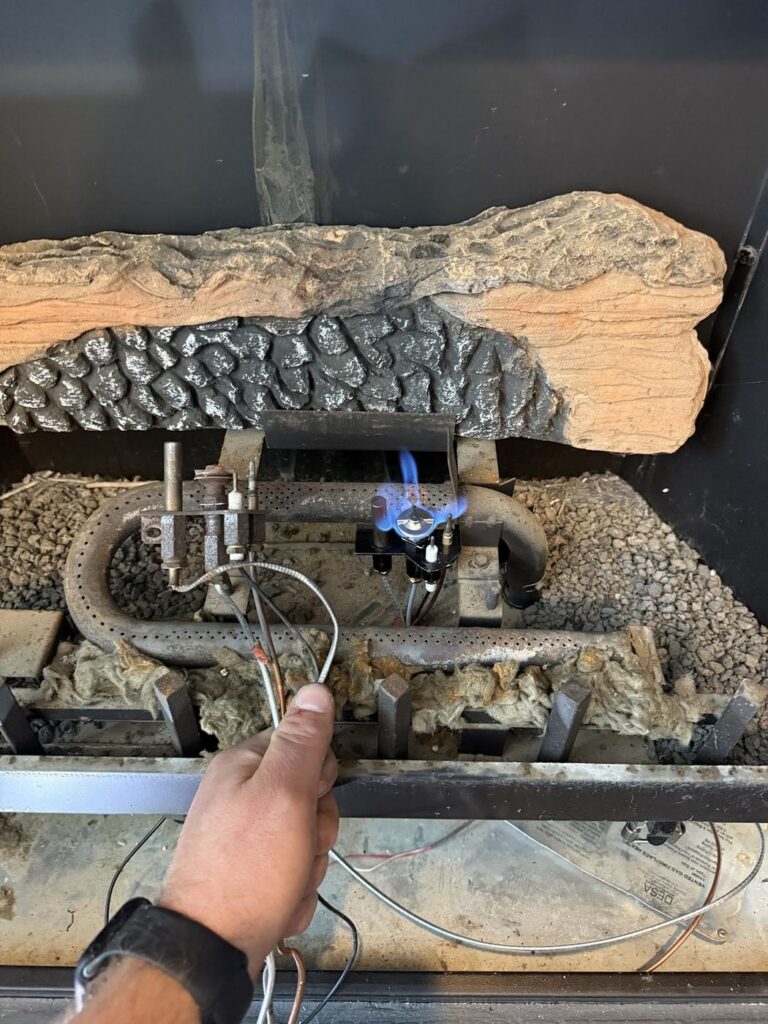
You flip the switch and nothing happens. Maybe a faint click behind the logs, maybe no sound at all, and the fireplace that ran fine in February sits there cold. Most of the time this is something small, and ten minutes of looking will tell you whether you can sort it out yourself.
Here is the order I work through when I walk into a house for a gas fireplace that will not light. I do it the same way every time, because jumping straight to the expensive answer is how people end up paying for parts they never needed.
Start with the gas itself
It sounds too simple to be worth writing down, and it is still something I find. Gas fireplaces almost always have a shutoff close to the unit: a key valve in the floor or wall beside the firebox, or a small quarter-turn handle on the pipe behind the lower louver. When that handle sits in line with the pipe, gas can pass. When it sits across the pipe, it is closed.
People close these in spring and forget by fall, or a plumber shuts one and nobody mentions it. If any gas work was done since your fireplace last ran, that is the first thing I look at, and it is safe for you to check too, because you are only reading the position of a handle. On propane, check the tank level first.
Is there a pilot, and is it lit?
Open the lower louver and look for a small flame near the burner, usually toward the left or the back. Older units keep a standing pilot burning through the season. Newer ones use electronic ignition that only sparks when you call for heat, so no flame is normal on those.
If yours has a standing pilot and it is out, a lighting sequence is printed on a label inside the unit or on the control valve. It is generally: turn the knob to PILOT, hold it down, spark the igniter, and keep holding for a good half minute after the flame catches. That hold matters, and the next section explains why.
If you smell gas at any point, stop. Not a faint whiff during lighting, but a real smell. Leave the house, do not flip switches on your way out, and call your gas utility from outside.
The thermocouple and the thermopile
This is the failure I find most often on older units. A gas fireplace has a small metal probe sitting directly in the pilot flame. Heat on that probe generates a tiny electrical current, measured in millivolts, and that current is what holds the gas safety valve open. It is a deliberate design: no pilot flame, no current, no gas. A thermocouple does that job for the pilot. A thermopile is a larger version that makes enough current to operate the main burner valve and the wall switch.
This is also why a standing-pilot fireplace keeps burning during a power outage. A millivolt system generates its own electricity from the pilot flame and does not need the house. If your unit has a blower, the blower stops without power, but the fire does not. Electronic ignition works the other way around: it needs power to make a spark, so on those units a tripped breaker, an unplugged outlet, or a dead battery backup pack really can be the whole problem.
When one of these parts weakens with age, you get the classic symptom: the pilot lights while you hold the knob down and dies the moment you release. Or the pilot stays lit but the main burner ignores the switch. I put a meter on the output rather than guessing, because a tired thermopile and a bad wall switch look identical from the couch.
A dirty pilot hood
The pilot orifice is a very small opening. Over a Texas summer it collects dust, and spiders genuinely do nest in pilot assemblies. A partly blocked orifice gives a lazy yellow flame that drifts instead of a crisp blue one wrapping the probe, and a weak flame cannot heat the probe enough. The fireplace then behaves exactly as though a part has failed when all it needs is cleaning.
That is why I pull the assembly and look before I sell anybody a part. I photograph what is in there, show you on my phone, and give you a written estimate for what it actually needs. If you want to see what a visit on a gas unit covers, I set it out on my gas fireplace service page.
The switch, the remote, and the interlock
These are fair game to check before calling anyone:
- Batteries. Fresh ones in the handheld remote, and in the receiver — it usually has its own tray behind the lower louver, and that is the one everybody forgets.
- The receiver switch. Many have a slider marked REMOTE, OFF and ON. If it has drifted to OFF, nothing will fire.
- The glass front. Some sealed units have a safety switch that blocks the burner if the glass is not seated properly.
Where to stop: the gas valve, the burner orifices, the venting, and the pilot assembly. Those need a meter and someone who works on these regularly.
If you have been through the list and it still will not light, call or text me at 214-300-5295 and tell me what it does and does not do. That description usually tells me a lot before I ever get there.