 Licensed & Insured |
  Free Written Estimates
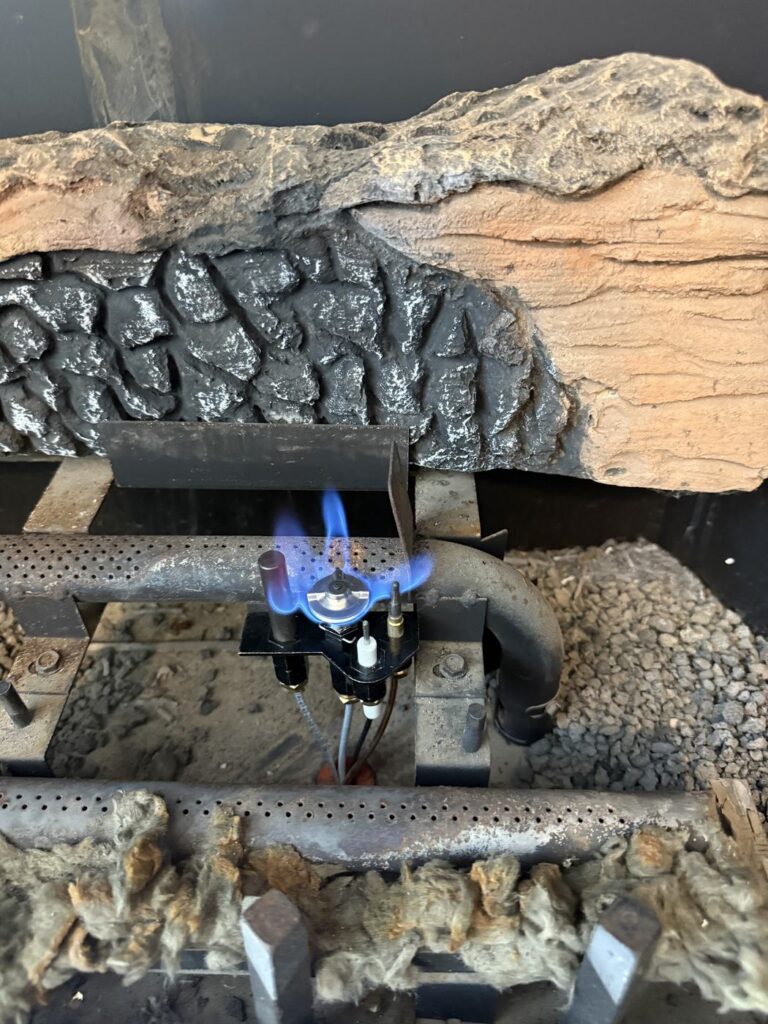
You hold the knob down, the pilot catches, you let go, and a few seconds later it is dark again. Maybe it holds a minute. Maybe it lasted all last winter and now will not get through an evening. It is one of the most common calls I get, and the causes are few and easy to explain.
The useful thing to understand is that a pilot going out is not a malfunction on its own. It is a safety system doing exactly what it was built to do. The question is why it decided to shut the gas off.
What the pilot is actually for
Two jobs. It gives the main burner a flame to light from, and it proves to the gas valve that there is a flame in the firebox. That second job is the important one.
Sitting in the pilot flame is a small metal probe. Heat on that probe generates a small electrical current, measured in millivolts. That current is what holds an electromagnet inside the gas valve open. Take the flame away, the current dies within seconds, the electromagnet lets go, and the valve shuts. That is the whole reason your fireplace does not quietly fill the room with gas when a flame blows out.
So when a pilot will not stay lit, one of three things is happening: the probe is not making enough current, the flame is not touching it properly, or something is blowing the flame around.
The thermocouple and thermopile
These are the current-making parts, and they wear out. A thermocouple is a single thin probe that produces just enough millivolts to hold the pilot valve open. A thermopile is a thicker one that makes considerably more, enough to also run the main burner valve and the wall switch without any house power.
They fail slowly. Output drops a little each season until it falls below what the valve needs to stay latched. That is why the symptom creeps up on people: first the pilot needs a longer hold, then it holds only sometimes, then not at all.
The way I tell is by measuring. I put a meter on the output while the pilot burns and read what it is actually producing, then compare that against what the valve needs. That reading separates a part that is genuinely dead from a part that is fine but not being heated properly. Without it you are swapping parts and hoping.
A dirty pilot hood, and the summer spider problem
This is the cause people never expect, and it is genuinely common in North Texas.
The pilot orifice is a tiny opening — smaller than a pin. All summer the fireplace sits unused, dust settles into the assembly, and spiders build in it. Certain spiders are drawn to the additive that gives natural gas its smell, and a warm sheltered pilot hood is an appealing place to spin a web. Come October, that opening is partly blocked.
The result is a starved flame. Instead of a firm blue cone wrapping the probe, you get a small yellow flame that lifts or burns to one side. It never heats the probe enough to make full current, so the valve drops out. The part is perfectly good. It is simply not being heated.
The fix is mechanical: pull the assembly, clear the orifice, clean the probe, and reset the flame so it wraps the probe again. I photograph the assembly before I touch it and show you what came out, because a pilot full of web is easier to believe when you can see it. There is more about that visit on my gas fireplace repair and service page.
Draft, and the other outside causes
Sometimes the parts are clean and the flame is still being disturbed. Things I look at:
- Downdraft in the chimney. On a vented unit, cold air pushing down the flue washes across the pilot. It gets worse when the house is under negative pressure — a kitchen hood, a bath fan or a dryer can pull enough air to change what the flue does.
- A loose glass panel. On a sealed unit the seal is part of the design. A flattened gasket or unevenly clamped glass changes the burn.
- Air movement in the room. A ceiling fan above an open log set, or a supply register aimed at the firebox, is enough on a marginal pilot.
- Low gas pressure. Less common, and it usually shows up on more than one appliance in the house.
Cleaning or a part? How I tell you which
Plainly: if the flame looks wrong, it is usually a cleaning. If the flame looks right and the millivolt reading is low, it is a part. If the flame looks right and the reading is good but the pilot still drops out, I am looking at the valve or at draft.
I would rather find the cheap answer, because the alternative is you calling me back in a month with the same problem and no confidence in what I told you. Either way you see the photos and get a written estimate before I do the work.
If your pilot has started dropping out, call or text me at 214-300-5295 and describe what it does — how long it holds, and what the flame looks like. That alone narrows it down before I arrive.