 Licensed & Insured |
  Free Written Estimates
The first real cold front in Dallas-Fort Worth usually lands somewhere between mid-October and mid-November, and it does not ease in. Seventy-eight degrees on Tuesday, forty-one by Thursday morning. Thursday night is when most people light the first fire of the season, and it is also when I get the calls about smoke rolling back into the living room instead of going up the flue.
Most of it you can check yourself in twenty minutes, in daylight, while it is still warm out. Here is the order I would go in, and where the line falls between what you can look at and what needs a person on the roof.
Start at the curb and look up
Walk out to the street, turn around, and look at the chimney against the sky. You are not inspecting it. You are looking for what changed since last winter.
- Does it stand straight against the roofline, or does it lean slightly away from the house?
- Dark staining running down the brick, usually worst near the top. That is often water coming in through the crown and working its way back out through the face.
- Brick faces flaking, or mortar joints gone soft and recessed. Water soaks into masonry, sits there, and the freezing nights January brings push it apart from the inside.
- The metal flashing where the chimney passes through the roof. Lifted at the edge, rusted, or patched with black tar that has since cracked is a leak waiting for the next storm.
Take a photo with your phone, zoomed all the way in. It catches what your eye skips.
Inside the firebox, with a flashlight
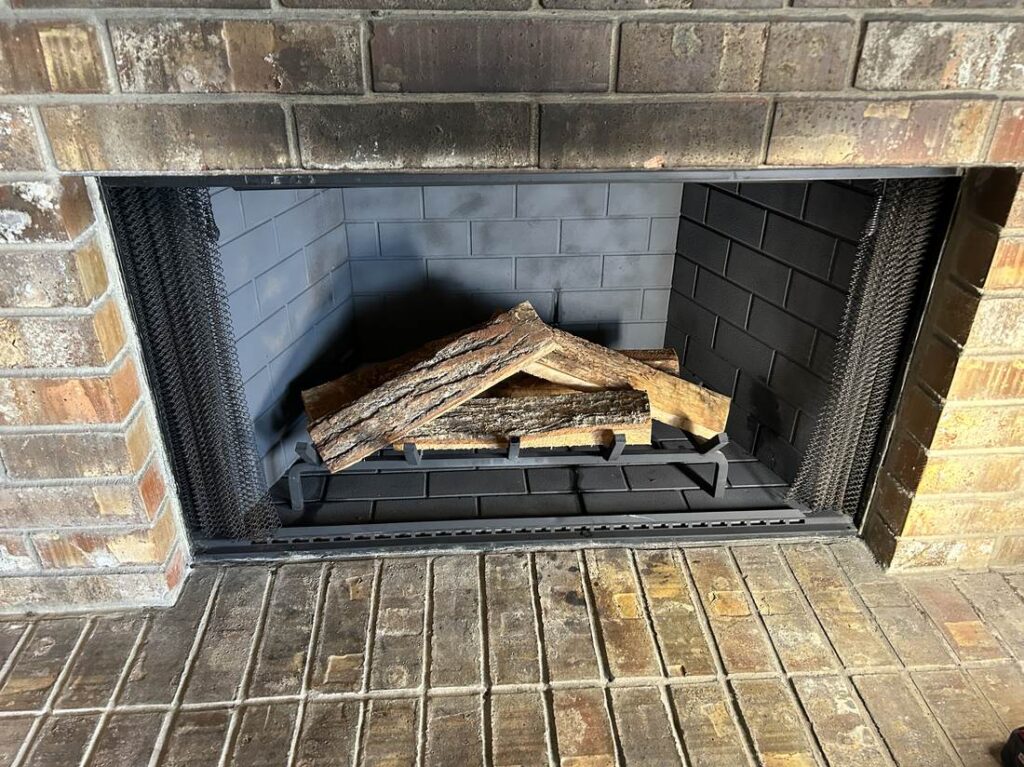
Open the glass doors or pull the screen back, and look at the firebrick and the mortar joints between the bricks. Hairline cracks in brick faces are common. Joints opened wide enough to slide a coin into, missing chunks of brick, or a back panel separating from the side walls are a different matter, because that layer holds heat off the framing behind it. On the firebox floor, leaves, twigs or dried grass mean something has been living up there, and rust flakes or water staining mean rain is coming down the flue.
The damper test
Reach up into the throat and find the damper handle. Work it fully open and fully closed two or three times. It should move without a fight and stay where you set it. A damper stuck half open bleeds heated air out of the house all winter. A damper stuck closed is the most common reason a first fire fills a living room with smoke. If it is seized with rust, do not force it hard enough to snap the arm.
Looking up the flue
With the damper open, shine the light straight up from just inside the opening. On most fireplaces you will see daylight at the top, dimmed and broken into squares by the cap mesh. Some flues offset on the way up and never give a clean view, so no daylight does not by itself mean a blockage. A dark mass sitting in the middle of the opening does. Look at the walls too. Dry gray-black dust is normal soot. A shiny, tarry, crusted coating is hardened creosote, and that is the one that turns a chimney fire serious.
The smell test
Pick a warm, humid afternoon with the air conditioning running and stand near the open fireplace. A house under negative pressure pulls air down the chimney, and a flue that needs cleaning will tell you so, with a sharp, sour, wet-ashtray smell that gets stronger the longer the unit runs. That smell comes off creosote in the flue, so a chimney sweep and flue cleaning removes the source. Straight answer, though: if the masonry has been soaking up that odor for years, cleaning knocks it back rather than erasing it, and the rest of the fix is stopping the house from pulling air down the chimney.
A musty, damp smell is usually water rather than creosote, which points back at the crown, the flashing, or a missing cap. One thing that is not a smell test: if you have gas logs and you ever smell gas, do not investigate it. Get everyone out of the house and call the gas company from outside.
The cap and the screen, without a ladder
You can see the top of most chimneys from an upstairs window, or from the yard with your phone camera zoomed in. What you want is a cap sitting square and level on the flue, with intact mesh screen on every side. A missing cap sends rain straight down onto the damper and smoke shelf. A torn screen is an open door for birds and squirrels, and a nest built in spring is still in there in November.
What genuinely needs a person on the roof
Four things, honestly. The crown, because hairline cracks in it are invisible from the ground. The flashing, because the failure usually hides under the shingle edge. The cap, because reinstalling one is roof work. And the flue above the smoke chamber, where a flashlight from the firebox shows you almost nothing.
That part is my job. I photograph what is up there and show you on the screen before I say a word about repairs, so you are looking at your own chimney instead of taking my word for it. Anything that needs fixing goes in a written estimate, and you decide on your own schedule.
If something on this list looked wrong to you, or you would rather have it checked before the first fire than after, call or text me at 214-300-5295. It is just me on the truck, and October is a far easier month to get this done than December.