 Licensed & Insured |
  Free Written Estimates
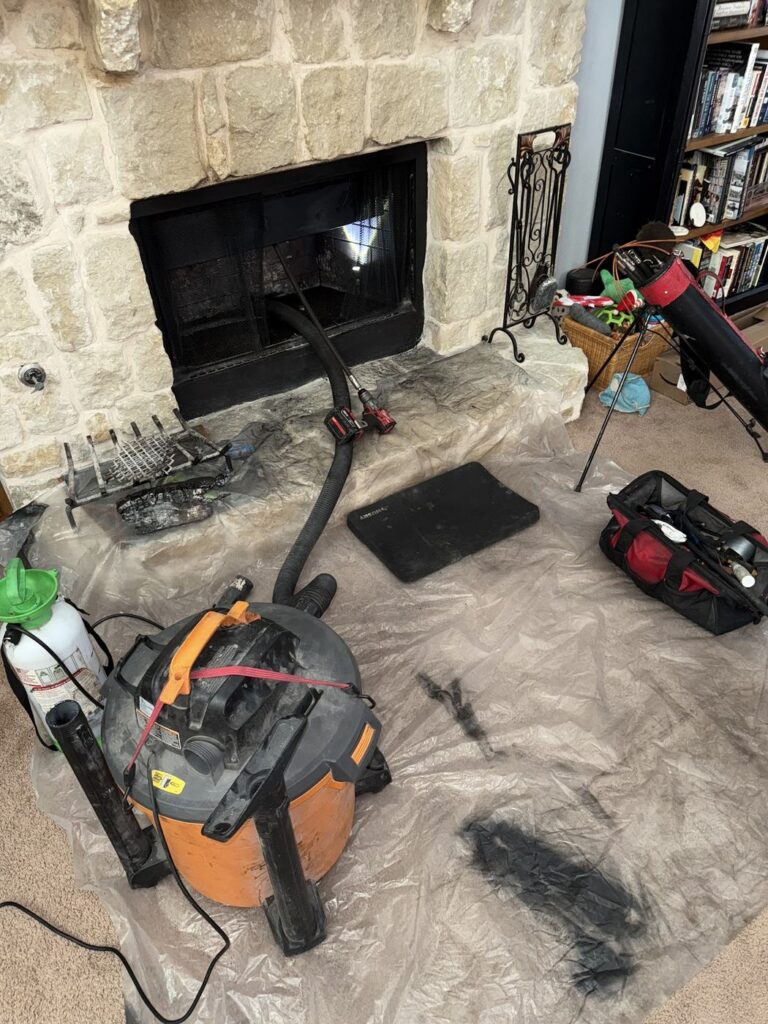
Almost nobody calls me in October. The phone starts the week the first hard front comes through, which in Dallas-Fort Worth is usually late November or the first week of December, and by then two things have already happened to your chimney. The wet season has come and gone, and every other homeowner in the metroplex has decided the same week that today is the day.
There is a real reason October is the better month, and it has nothing to do with a sales calendar. It is rainfall.
October is the second-wettest month in Dallas-Fort Worth
Using the 1991-2020 climate normals for DFW Airport, average rainfall is 2.72 inches in September and 4.37 inches in October. That makes October the second-wettest month of the year here, behind only May at 4.78 inches. The source for those numbers is NOAA / National Weather Service.

Put another way, October brings 61% more rain than September does. Most people I talk to have that backwards. Fall reads as the dry, pleasant stretch between the summer heat and the winter cold, so a chimney that got through August without a problem feels like it is fine. It is not fine. It is about to be tested harder than it has been since spring.
What that rain does to a chimney that is not sealed
A chimney is a masonry box with a hole in the top, standing above the roofline with all four sides exposed. Water gets in three ways, and none of them are dramatic enough to notice from the couch.
- A cracked crown. That is the concrete slab across the top. Hairline cracks let water into the gap between the flue tile and the brick, where it has nowhere to go.
- Failed flashing. Where the chimney comes through the roof, water gets under the metal and follows the framing into the ceiling below.
- A missing or damaged cap. Rain falls straight down the flue onto the smoke shelf and the damper.
In September, a small crack takes 2.72 inches. In October it takes 4.37, then November and December pile on top of that. That is the part that matters. By the time you call in December, the same small defect has been fed for two straight months. Water standing in a flue rusts a damper until it will not move. It washes mortar out from between flue tiles. Mixed with creosote it turns acidic and eats masonry from the inside. The ceiling stain that shows up in January started as a crown that could have been sealed in early October.
If the flue itself is what needs attention, that is the straightforward version of this job, and a chimney sweep and cleaning in October is a very different appointment than the same work squeezed into a rainy week in December.
Everybody calls in the same seven days
The second reason is simpler, and I will be blunt about it. There is one of me. I do every job myself, so the number of chimneys I can get to in a week does not change when demand triples. When the first front hits, the calls arrive in a bunch, and the week you want is the week everyone else wants.
In October the calendar has room in it, and you pick a morning that works around your job and your kids. In the first cold week of December you take what is open, and if there is repair work to schedule after that, you are trying to get it done in winter weather on a wet roof.
What October actually buys you
Three things, and none of them are about me having an opening.
A dry roof and daylight. I can be up there safely and actually see what I am looking at. Crown cracks and flashing failures are found by looking closely at them, not by guessing from the ground.
Time to decide. If I find something in October, you are not choosing between a cold house and an unbudgeted repair. You have weeks. You can take the written estimate, think about it, ask someone else, and still have the fireplace working before Thanksgiving.
Seeing it yourself. I photograph what I find and show it to you on the screen before I say anything about fixing it. You look at your own crown, your own flashing, your own flue, and you decide. Nobody should approve a repair they have never seen, and October is when there is time to actually look.
If it is already December
Call anyway. A late sweep beats a skipped one, and plenty of chimneys need nothing more than cleaning. Just know that any water damage has had a head start. If you have seen water in the firebox, smelled something musty, or watched smoke come back into the room, hold off on burning until someone has looked at it.
If you would rather get ahead of it, call or text me at 214-300-5295 and I will find you a morning in October. I will show you what I find before I say a word about repairs, and you can take it from there.